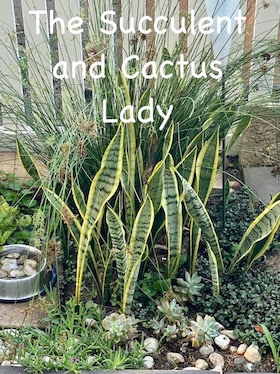
About me

About me
🌿 I've been gardening ever since a child, when I spent time with my father in his vegetable garden. But my fascination with Echeverias started in the 1980's, when my father gave me a pot with five Echeverias, which turned out to be E. imbricata. At first I wasn't much interested in them and planted them in some obscure corner of the garden and completely forgot about them. How great was my surprise when, a couple of months later, I noticed that they had spread and made a beautiful display - I was hooked!
Showing posts with label flowers. Show all posts

Tuesday, 17 June 2014

Aloe ferox splendour


My aloes (this is Aloe ferox, also known as Bitter aloe) have started flowering and I'm beside myself with joy! Two seasons ago I had no flowers, an early frost annihilated the lot just as the buds started. I actually know what the problem is - since I planted them 7 years ago, the trees surrounding them have grown huge, resulting in a lot of shade. So I have two options - cut down the trees (no ways!) or move the aloes to full sun, which is going to be a huge task. As you can see from the photo below, taken this past summer, they are very big and I'm not looking forward to this mammoth task. Wouldn't it be easier to lose them (sob, sob!) and just plant new ones in a sunny spot...?


This hardy plant is indigenous to South Africa, and with its succulent leaves can survive the harshest conditions. When damaged by man or animal, the plant seals off any wound with a sticky, dark liquid that prevents infestation by virus, fungus or insect. This dark liquid has been successfully used by ancient inhabitants as a traditional remedy for many ailments.

.

Wednesday, 19 March 2014

Carpobrotus


I used to have stretches of this wonderful ground-cover in my last garden. This easy-to-grow succulent, native to South Africa, is a wonderful ground-cover, ideal for low-maintenance and water-wise gardens.

Leaves are eaten by tortoises. Puff-adders and other snakes such as the Cape Cobra are often found in Carpobrotus clumps where they ambush the small rodents that are attracted by the fruits. Flowers are pollinated by solitary bees, honey bees, carpenter bees and many beetle species. Flowers are eaten by antelopes and baboons. The clumps provide shelter for snails, lizards and skinks, so it’s a wonderful plant to have if you want to attract wildlife to your garden.

CARPOBROTUS C. acinaciformis (sour fig, elandsvy, goenavy, Hotnotsvy, strandvy, suurvy ) has purple flowers, robust, short, greyish green, sabre-shaped leaves and tasty edible fruits, used to make a delicious jam, and grows in coastal sands usually close to the sea, in the Western Cape, from Saldanha to Mossel Bay (South Africa).

Carpobrotus juice (from leaves) can be used as a mild astringent. When mixed with water the juice can be used to treat diarrhoea, dysentery and stomach cramps. It can also be used as a gargle for sore throat and laryngitis, and mild bacterial infections of the mouth. The leaf juice can also be used externally, much like Aloe Vera for burns, abrasions, open cuts, grazes, mosquito bites and sunburn. It is also used to treat ringworm, eczema, dermatitis, herpes, thrush, cold sores, cracked lips, chafing, skin conditions and allergies.
Info from Wikipedia

 
CONSERVATION STATUS 
Carpobrotus edulis is not regarded as threatened in its native habitat, but it is invading natural areas in other parts of the world and threatening the survival of other species. In California, where it has been used since the early 1900s to stabilize the soil along railway tracks and roadsides and as a garden ornamental, it has naturalized and is invading coastal vegetation from north of Eureka to Rosarita Bay. It is known as the highway ice plant in the USA. It has naturalized along the west coast of Australia from Perth to Albany where it was also used for soil stabilization and is known as pigface. It has naturalized in parts of the Mediterranean and on the south coast of England.


.

Thursday, 6 February 2014

Rattail Cactus (Disocactus flagelliformis)


I have two of these Raittail cacti and every September I’m rewarded with the most beautiful flowers after they spent the winter inside. These cacti like temperatures above 35°F (3°C) and do not tolerate any frost.

The Aporocactus or Disocactus flagelliformis (rat tail cactus, rat’s tail cactus) has thin weak stems (usually about a half inch in diameter) that can grow five feet long and hang down over the sides of its pot. I currently have two of these, which I bring inside every winter as they do not do very well in frost. But they do need to be kept cool in winter to encourage flowering in spring. 


Water this plant frequently in the summer and much less in winter. Add water at the top of the pot or container and allow it to seep through to the drainage holes, then remove the excess water from the pot tray. Keeping the soil slightly moist is also advisable in summer.


The rat tail cactus needs bright light and coarse heavy soil with excellent drainage. Drench and let dry, but water more sparingly during the winter. Air that is too dry can encourage red spider; air that is too moist can encourage rot. In Mexico they grow at high altitudes where the night temperatures are very brisk. In rural areas the dried flowers are used medicinally.


The bright pink flowers, 1.5 inches long, 2.5 inches wide (4 by 6 cm), are produced along the long, trailing stems in spring and summer are sometimes followed by small red fruits. In the wild, they are pollinated by hummingbirds, but in cultivation, they generally need to be hand pollinated.


Native to regions of Mexico, it is an epiphytic cactus in the wild, meaning it naturally grows in trees.


::

Related Posts Plugin for WordPress, Blogger...