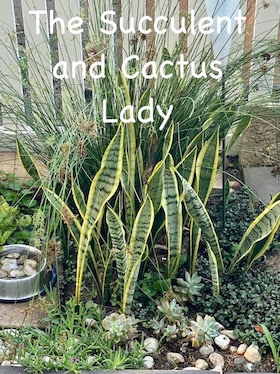
About me

About me
🌿 I've been gardening ever since a child, when I spent time with my father in his vegetable garden. But my fascination with Echeverias started in the 1980's, when my father gave me a pot with five Echeverias, which turned out to be E. imbricata. At first I wasn't much interested in them and planted them in some obscure corner of the garden and completely forgot about them. How great was my surprise when, a couple of months later, I noticed that they had spread and made a beautiful display - I was hooked!
Showing posts with label succulents. Show all posts

Wednesday, 21 July 2021

Winter splendour at the Coast

ALOES, ALOES EVERYWHERE!

There are over ±155 Aloe species in our country (South Africa) ranging in size from the large Tree Aloes (Aloidendron) to the attractive little Grass Aloes with the Creeping Aloes (Aloiampelos) in between.

This is the time of year (Winter) when these striking flowers are at their best. Aloes attract a variety of insects and birds, particularly Sunbirds.

Take a moment to watch them.


(The above pics taken at The Quarter, Ballito, KZN)

Found this beautiful Aloe chabaudii on one of our morning walks along the promenade on the Beach (Ballito, KZN)

Found this beautiful Aloe chabaudii on one of our morning walks along the promenade on the Beach (Ballito, KZN)

Found this beautiful Aloe chabaudii on one of our morning walks along the promenade on the Beach (Ballito, KZN)

Aloe just outside Caledon Estate in Ballito, KZN, South Africa 

Aloes just outside Caledon Estate in Ballito, KZN, South Africa  


The flowers of Aloe marlothii attract a plethora of insects and birds, supplying much-needed sustenance in the cold winter months

Aloe arborescense - Ballito, KZN

Aloe arborescense - Ballito, KZN


One of my all-time facourites is Aloe ferox, a true gift from nature. It's not really found at the coast, but I just have to include it here. The world over, users revere aloe ferox for it’s numerous properties. The bitter sap contains powerful anti-oxidant properties – an ancient source of a modern cosmetic buzzword. Healing, detoxifying, anti-inflammatory, Anti Bacterial, Anti-Viral and Anti-Parasitic – and those are only a few ways in which Aloe Ferox helps in maintaining personal wellness. It is an important life-line for insects and birds in winter, supplying much-needed sustenance in the cold months.

For centuries indigenous healers have treated man and beast successfully with aloe preparations. In Xhosa culture here in South Africa, it is applied to fresh and inflamed wounds to encourage healing and is a known cure for ring-worm and tapeworm, boils and ulcers. Aloe is used to treat enteritis in calves and fowls, as well as roundworm in the Zulu culture, while the Pondo mix aloe juice and water for a refreshing body wash. An extract, bitters, is ingested to help with detoxification, as well as gout, rheumatism and arthritis, stomach and digestive ailments.

Other recorded uses include: insect bites and bluebottle stings, fungi, toothache, sunburn, as protection against the elements and to stimulate the immune system, to name a few.


Tuesday, 26 March 2019

Succulent addiction

(A warning: If you have any propensity towards cactus love to begin with, moving to the desert will increase it exponentially!) 


The funny thing about succulents is, once the bug has bitten you, it lasts forever. When we left Gauteng a year ago, I gave all my babies away to a good home, often thinking about them, missing them and visualizing starting a new family as soon as I could.

My new (temporary) home didn't allow for much gardening, but the minute I could, I found a space, called it my 'propagation station', and lovingly cultivated a few cuttings. Most were cuttings or leaves given to me by friends and other succulent-lovers and some were collected the old-fashioned way, picking up shed leaves and broken pieces off garden pavements.

Next month we are moving to our permanent coastal home (yes, we decided to stay in KwaZulu Natal!) and now my little collection is ready for re-location to their new home. Soon I'll be able to dig into some soil again and feel the earth move beneath my feet! 💚💚💚

Thursday, 27 December 2018

A new beginning...


After giving all my succulents away when I left Gauteng last December 2017, I have now acquired a brand new little piece of Crassula tetragona - a new beginning! Pronounced KRASS-yoo-la tet-ra-GON-uh subsp. row-BUS-tah.

Afrikaans: Karkai (Ken enigiemand hierdie Afrikaanse naam...?

Tetragona is a unique variety of evergreen succulent that is native to South Africa and also known as the Miniature Pine Tree due to its foliage resembling a pine tree. Often used as a popular bonsai specimen, grows well in pots or in the ground and grows to a height of 1 meter, this plant grows well in full-sun to partial sun, needs a good water when the soil has dried out.

Native to Southern Africa, it is widely distributed from the Orange River boundary of Namaqualand to beyond the Kei River in the Eastern Cape. Wikipedia says "Tetragona" comes from the phyllotaxy of the leaves. It is popularly named the "miniature pine tree" among ornamental plant enthusiasts, for its popular use as a "pine tree" in Bonsai.

(Pic taken in my bedroom in Sheffield Beach, Ballito, KwaZulu Natal)

Wednesday, 26 December 2018

Haworthia cooperi


I've never had much success with growing Haworthia Cooperi. This one of mine started deteriorating soon after I acquired it until it was completely dead!

Haworthia cooperi is a diverse and varied species of the genus Haworthia in the family Asphodelaceae, endemic to the Eastern Cape Province in South Africa. It is a fast growing, clustering species with soft, fleshy foliage (the leaves have the feel of tiny, plump grapes). While it clusters, it adds additional offsets slowly, gradually increasing its size to fill a 3 to 4 inch pot.

This plant thrives in dappled shade and I think the mistake I made was to let it get too much direct sunlight. Another factor is that the haworthias show evidence of stress when temperatures become very high (above the mid 90°F - 32°C), which was often the case in my garden, even when the plant was in the shade.
Fat juicy leaves and translucent flesh are the hallmarks of Haworthia window plant. Not all Haworthia have the see-through leaves, but those that do are spectacular specimens of the genus

Read more at Gardening Know How: How To Grow Haworthia: Information On Caring For Window Plants https://www.gardeningknowhow.com/ornamental/cacti-succulents/haworthia-cacti-succulents/haworthia-window-plants.htm

Fat juicy leaves and translucent flesh are the hallmarks of Haworthia window plant. Not all Haworthia have the see-through leaves, but those that do are spectacular specimens of the genus.

Read more at Gardening Know How: How To Grow Haworthia: Information On Caring For Window Plants https://www.gardeningknowhow.com/ornamental/cacti-succulents/haworthia-cacti-succulents/haworthia-window-plants.htm

Monday, 24 December 2018

Festive Greetings 2018


Wishing you and your succulents a magical and blissful holiday! May this Christmas season bring you nothing but fond gardening memories, happiness and laughter!

Saturday, 22 December 2018

Canned gardening


Use empty food tins as pots for your succulents. Just remember to punch a few holes in the bottom to enable good drainage.

Wednesday, 19 December 2018

Hoya kerrii ‘Variegata’


My Mother's Day gift this year (May 2018), Hoya kerrii ‘Variegata’ (Sweetheart Hoya) is a climbing plant that can grow up to 13 feet (4 m) tall. The stems are up to 0.3 inch (7 mm) in diameter. The leaves аrе thick, variegated, heart-shaped, are up to 2.4 inches (6cm) wide. Adult plants show inflorescences of up to 2 inches (5cm) diameter and up to 25 small, star-shaped flowers, creamy-white with pink to rose-purple centers. Also called Wax Plant.

Hoya plants don’t ask for much, beyond the well-draining soil and the warm humid conditions that many tropical flowers crave. They don’t like wet feet or heavy soil, and as many grow as epiphytes in nature (similar to bromeliads and orchids). Give them at least a half day of sunshine, and bring them indoors when temperatures drop below 50°F (10°C).

When your Hoya finishes blooming, leave the flower stalk, as it may produce new flowers. Removing the stalk forces the plant to produce a new stalk, which delays blooming and wastes the plant’s energy. They are light feeders, and a monthly drink of compost tea or dilute fish emulsion provides all the nutrition these tropicals need. Hoyas like the security of a snug pot, and plants that are a bit root bound will flower more prolifically than those that are swimming around in a giant pot. Hoya is native to the south-east of Asia.


Wednesday, 12 December 2018

Mother-in-Law's Tongue


Have you ever seen Mother-in-Law's Tongue flowering? Well, here it is! (Sansevieria trifasciata).


Also known as the Snake Plant, it this lovely feature plant is easy to propagate and looks great planted en masse in the garden or in pots on the patio or in your home. They thrive in in both bright and low light areas.


As a houseplant, it does best in bright light but handle low light levels indoors as well. Outdoors bright light to full sun. Handles dry and poor soil conditions but appreciates good well-drained soil inside or outside. Lightly fertilize with a liquid 20-20-20 fertilizer 1/2 strength. DO NOT over-water or over-pot. Temperatures below 4℃ may cause damage to leaves. Relatively pest free.

Saturday, 8 December 2018

Firesticks - Euphorbia tirucalli

Firesticks - Euphorbia tirucalli in the Summer on the North Coast, Ballito, KZN - green with no yellow or pink (Sheffield Beach, Ballito)

 This is what Firesticks - Euphorbia tirucalli - looks like in winter on the North Coast, KwaZulu Natal - note the beautiful pink colour on the tips. And here they grow absolutely HUGE! (Sheffield Beach, Ballito)

It has been said that the pink and orange colours only come out when the plant is grown in the shade, but this specimen is in full sun year-round. 

Tuesday, 18 July 2017

The beauty and ease of Echeverias


With their wonderful grey-green waxy colours and absolutely symmetrical appearance, Echeverias must certainly be one of the most beautiful succulents on our planet. Add to that the ease with which they propagate and the minimal care they need, and you have a winner!

Echeverias are native to semi-desert areas of Central America, Mexico and north-western South America and although they do thrive in hot, desert conditions, with a bit of extra water you will have the biggest and most gorgeous plants that reward with lots and lots of flowers.


Most will tolerate shade and some frost, although hybrids, like this E. imbricata (or glauca), tend to be less tolerant. I often bring my most prized plants which are in pots, indoors for winterizing.

 Echeveria imbricata planted in an old dog basket


 Large Echeveria imbricata (10" in dia), sharing a concrete pot with some waxy-green Aeoniums. A shade-loving Aloe zebrina took hold at the base of the pot, probably a seed spread by birds.

The beautiful flowers of E. imbricata

Once they start flowering, there's no stopping them!

This succulent propagates by making lots of pups which can be separated and planted out to form new clumps and in a few months you could have cultivated a beautiful collection! It is also easily propagated by taking a leaf and sticking it in some sandy soil, keeping it slightly moist until roots have formed, when a new little plant will emerge next to the leaf cutting. 

A few Echeverias planted in front of some Phormiums soon spread to cover the whole area in a matter of two seasons.


Thursday, 29 December 2016

Starting over

Aloe ferox youngsters in my garden having survived another winter

Have you ever jumped the gun and then regretted it afterwards? Well, that's what happened to me! A couple of months ago we were in the process of selling our smallholding, something we've been thinking of for a couple of years now, planning retirement and all that, and apart from having to have a massive clean-up of all the stuff one accumulates over 38 years of living in one place, one of my biggest worries was all my succulents - those in the garden were OK, but I had dozens of succulents and cacti in pots and it was impossible for me to take all of them with me. After a short search I was lucky and blessed enough to find another succulent-lover who was thrilled to take all of them off my hands.

Now, here's the thing - the sale fell through! (Much to my relief, I must say, as in the process of selling we suddenly realised what we are leaving behind and we fell in love with our life and our smallholding all over again! One doesn't realise what you have until you lose it, or almost lose it, right?)

This new planting was just coming along nicely and the Aeoniums on the left were some of my favourites.

This Echeveria elegans was also just starting to flower for the first time in in about the 4 years I had it

Another first, this Haworthia cooperii var Transiensis was also pushing up it's first tiny little flowers

My only consolation is that I still have a few succulents and cacti left in the garden and it would be easy to take cuttings and start a new collection. But here's the question : do I want to start another potted collection again? At first, after they were all gone, I felt empty and lost, no daily routine of checking up on all of them, spotting new growth and new flowers and softly chatting to each and every one. All their small watering cans are standing empty, calling out for something to water.

But on the other hand, it's also very liberating to not constantly be worried about them and rushing outside to bring them under cover every time it starts hailing. So, for now, I'll be chatting to all my succulents and cacti in the ground in the garden, checking on them daily and giving them some special attention!


Friday, 9 September 2016

Succulents flowering in September 2016

The weather has warmed up after a severe and stormy winter and my succulents are celebrating spring!

My Echeveria elegans flowring for the first time!
Echeveria "Lipstick" also flowering for the first time even though it suffered severely from the hailstorm we had

My Echeveria imbricata after the severe hailstorm we had at the end of July - they should all have been plump, beautiful and flowering now

Haworthia cooperii var transiensis -  first flower

Pleiospilos Nelli first Flowers since I acquired her
The Vygies never fail to delight! Mesembryanthemum Lampranthus (Delosperma cooperi)

 As soon as I brought the Rattail cactus outside from indoors where it spent the winter, it started sprouting it's beautiful flowers

The gorgeous flower of the Rattail cactus (Aporocactus-flagelliformis)

 One of my Echeveria imbricata is sporting yellow flowers, a first in the 20-odd years I've been growing them. It is also making a baby along one of the flower stems, I think that is called "sporting".

( A sport in the plant world is a genetic mutation that results from a faulty chromosomal replication. The results of the mutation are a segment of the plant that is distinctly different from the parent plant in both appearance (phenotype) and genetics (genotype). The genetic change is not a result of unusual growing conditions; it is an accident, a mutation. In many cases the new trait can be handed down to the organism’s offspring.)

Read more at Gardening Know How: Plant Sport Mutations – What Does It Mean WhenA Plant “Throws A Sport


A sport in the plant world is a genetic mutation that results from a faulty chromosomal replication. The results of the mutation are a segment of the plant that is distinctly different from the parent plant in both appearance (phenotype) and genetics (genotype). The genetic change is not a result of unusual growing conditions; it is an accident, a mutation. In many cases the new trait can be handed down to the organism’s offspring.

Read more at Gardening Know How: Plant Sport Mutations – What Does It Mean When A Plant “Throws A Sport” http://www.gardeningknowhow.com/garden-how-to/info/plant-sport-mutations.ht
A sport in the plant world is a genetic mutation that results from a faulty chromosomal replication. The results of the mutation are a segment of the plant that is distinctly different from the parent plant in both appearance (phenotype) and genetics (genotype). The genetic change is not a result of unusual growing conditions; it is an accident, a mutation. In many cases the new trait can be handed down to the organism’s offspring.

Read more at Gardening Know How: Plant Sport Mutations – What Does It Mean When A Plant “Throws A Sport” http://www.gardeningknowhow.com/garden-how-to/info/plant-sport-mutations.htm
 Just before the sun gets to it, the Mammillaria's flowers are still closed. This one is now starting to form a very nice ring around the crown.

::

Sunday, 29 May 2016

Living rock of South Africa - Titanopsis flowering

It's winter here in South Africa, which means all the cacti and succulents are flowering! The Aloe ferox hasn't started yet and I'm just hoping we don't get any frost this year, last year I only had one flowering due to heavy frost.


The Titanopsis calcarea which I acquired last year in February is now flowering for the first time and the flowers are tiny, really tine, 10mm, but how gorgeous!


Titanopsis is a small genus of dwarf succulents from the family of Aizoaceae. Naturally growing in the Upper Karoo in South Africa, Titanopsis is an attractive but quite unusual plant because of its formation. The plant grows as a dwarf succulent and produces thick truncated leaves that have crumpled surface. These unusual leaves display all the hues of red, purple, green, cream and blue throughout the year. Flowers appear in late fall and winter. Like its cousins in the Aizoaceae family, Titanopsis produces small daisy-like flowers of yellow colour.

Titanopsis genus occur in three separate areas of southern Africa: southern Namibia, the region around the south-eastern border of Namibia and a larger area spanning between the former Cape Province and Orange Free State in South Africa. This unusual distribution means that the different Titanopsis species live in different rainfall systems - either summer or winter rainfall depending on the species. Cultivation is easy with full sun, very well-drained soil, and attention to the natural rainfall of the particular species' habitat.

It is a very rewarding succulent, and can be cultivated in desert gardens in warm climates or in greenhouses or windowsills in the home. Enjoys bright shade in summer and full sun in the other seasons. It requires watering fromautumn to spring, and less in summer. They grow quickly from seed or by division of larger clumps.

My Titanopsis last winter. As can be seen from the pics above, several new clumps have already formed. They are also sometimes referred to as Concrete Leaf or Jewel Weed.


Family: Aizoaceae (ay-zoh-AY-see-ee)
Genus: Titanopsis (ty-tan-OP-sis)
Species: calcarea (kal-KAR-ee-uh)


Related Posts Plugin for WordPress, Blogger...