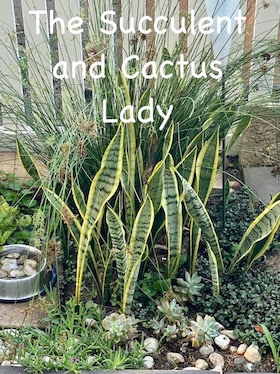
About me

About me
🌿 I've been gardening ever since a child, when I spent time with my father in his vegetable garden. But my fascination with Echeverias started in the 1980's, when my father gave me a pot with five Echeverias, which turned out to be E. imbricata. At first I wasn't much interested in them and planted them in some obscure corner of the garden and completely forgot about them. How great was my surprise when, a couple of months later, I noticed that they had spread and made a beautiful display - I was hooked!

Sunday, 29 March 2020

Aristaloe aristata, prevously known as Aloe aristata

We have finally moved into our new home and, of course, one of the first things I did was to visit the nearest garden centre. One of my latest acquisitions is a pot of Aloe aristata - Aristaloe is a genus of evergreen flowering perennial plant in the family Asphodelaceae, indigenous to Southern Africa. Its sole species is Aristaloe aristata, known as guinea-fowl aloe or lace aloe.


This semi-hardy succulent (does not tolerate frost at all) forms dense rosettes of fleshy, triangular leaves. These offsets that can be removed from the mother plant. Allow a day or two so that the wounds on the plants can callus, this will help prevent rot from setting in.

It grows up to 8 inches (20 cm) tall and about the same in diameter. The leaves are dark green, with small white bumps, bristly margins, and tipped with a soft white spine.


I have found that this little aloe does better in semi-shade or indoors, so my two are enjoying pride of place on my indoor plant shelf in my lounge, where it gets some great late-afternoon sun.


It will tolerate slight over-watering and drought conditions.But I would go slow on that "over-watering"! Just make sure the pot is well-drained and remove any water that might end up in the catch-plate under the pot.


This little aloe, although not threatened, is extinct in certain locations. It is found in the Eastern and Western Cape, Orange Free State and Lesotho.

Plants are stemless and form clumps of up to twelve rosettes that are between 100mm and 150mm in diameter. Flowers are a dull-red or pinkish colour, tubular in shape and slightly curved down.

A well drained soil is required, I use the following type of mix for Aloes that I grow in pots :
  1. 2 parts coarse sand.
  2. 1 Part well-sieved compost.
  3. 2 parts washed sand (from the garden).
If you are lucky enough to have one of these amazing little aloes, enjoy it to the full, love it a lot and it will give you lots of flowers!


Wednesday, 3 July 2019

Aloe thraskii (Dune Aloe)

Aloe thraskii (Dune Aloe)  

During one of our walks on the beach at Umdloti, not far from Ballito (KwaZulu Natal), I came across these large Aloes growing right on the beach. Fascinating! Not many plants can withstand the onslaught of wind and sea spray and yet, here was this beautiful specimen absolutely thriving in these conditions. Hence the name, Dune Aloe.

Indigenous to South Africa, it is a lovely plant for coastal gardens. This Aloe is a single-stemmed plant with giant, thorny-edged leaves that curve outwards and downwards, like fleshy arches. The sturdy inflorescence's with their racemes of bright yellow flowers appear in June and July and it is one of the few aloes that will withstand wet conditions

Pronunciation : AL-loh THRAS-kee-eye 
Afrikaans: Strandaalwyn
siXhosa: Ikhala
IsiZulu: Umhlaba 


The Dune aloe grows fast in cultivation and is especially suited for coastal situations as it tolerates wind and salt air. It can be grown in inland gardens with mild winters and not overly damp summers. 

It can grow up to 10 feet (3m) tall and is naturally found in dune vegetation along the coast of KwaZulu-Natal and the Eastern Cape of South Africa. It is a hardy plant but not completely frost resistant.


Aloe thraskii is classed as Near Threatened in its natural habitat, due to habitat loss from urban and coastal development and illegal collecting for the specialist succulent horticultural trade. Experts estimate that 20-30% of the habitat has been lost to urban and coastal development in the last three generations (generation length 20 years). Severe storms are also likely to become more frequent with climate change, and may impact more severely on dune systems in the future.

Friday, 28 June 2019

Candelabra Tree (Euphorbia ingens)

Something that has totally surprised me since we moved to the North Coast of KwaZulu Natal (South Africa) eighteen months ago, is the fact that succulents and cacti grow so beautifully here. I've never seen so many succulents as here in Ballito! I mean, a succulent and a cactus is a desert plant, and yet, here they are, thriving in a tropical, wet climate and being totally at home in an average rainfall of  828 mm (32.6in) per year. EVERY garden boasts dozens of succulents and probably never needs watering!


On my way to town one morning, I spotted these glorious flowers cglowing in the sunlight, so I stopped to take a picture. It was only then that I noticed the large Euphorbia hiding in the shade. At first glance it looked like the Euphorbia had these lovely flowers, but when I got closer, I noticed that the flowers belonged to the tree behind the Euphorbia, an Ant Tree (Triplaris americana), an alien invasive from, yeah, you guessed it, Central and South America. (You can read more about this tree HERE.


Afrikaans : Naboom

Native to South Africa, this tree prefers warm areas and can survive in areas that go through long periods of drought or are generally very dry. It usually grows on rocky outcrops or in deep sand within bush-veld vegetation. Distributed throughout KwaZulu-Natal, Swaziland, Limpopo Province, Gauteng, North-West Province, Mozambique, Zimbabwe and further into tropical Africa. If you are looking for a low maintenance addition to a rock or succulent garden, this large cactus-like tree is ideal. It can grow up to 40 feet (12m) tall,

The flowers attract butterflies, bees and other insects, which collect pollen and nectar from them, pollinating the trees in the process. The seeds are a good source of food for many fruit and berry eating birds. Birds also like nesting in these trees; hole-nesting birds such as woodpeckers often use dead sections.


It is important to mention that Euphorbia ingens is a poisonous plant. If ingested, the latex can pose certain health threats. It can cause skin irritation and even blindness on contact. Since it is considered to be toxic, a lot of people avoid planting them in areas accessible to children and pets.

There is a bright side to the toxic nature of this plant – the poisonous latex makes sure that pests bring no damage to the plants.


Monday, 24 June 2019

Crassula multicava

Crassula multicava (pics taken in Sheffield, Ballito, KwaZulu Natal

For months I've been passing this Crassula on my walks and then, suddenly this week, a pink mist of blooms greeted me as I rounded a bend. I knew all along that it was a Crassula, but the flowers finally allowed me to do a full identification.

Pronunciation - KRASS-yoo-la mul-tee-KAH-vuh
.
English: Fairy crassula
Afrikaans: Skaduplakkie
IsiXhosa: intelezi; phewula
IsiZulu: umadinsane

    •    Canopy Shade
    •    Deep / Full Shade
    •    Dry Shade
    •    Light or Dappled Shade
    •    Partial Shade
    •    Sun
.
Crassula multicava is particularly useful for dry shade and to cover unsightly spots. It is tender to frost. There is a distinct difference in appearance depending on the position in which the fairy crassula is planted: in deep shade the leaves are larger and dark green and the plant has fewer flowers while in full sun the leaves are smaller and light green and flowering is profuse.
.
The flowers are tiny stars on thin stems held above the leaves

And just look at all the benefits of this gorgeous ground-cover!

    •    Attracts bees, butterflies or other insects
    •    Border
    •    Container
    •    Edging
    •    Filler
    •    Ground Cover
    •    Mass Planting
    •    Pioneer for new gardens
    •    Rock Garden
    •    Stabilize Banks
    •    Suitable for coastal gardens
    •    Wild Garden


Indigenous to South Africa, it is found from the southern part of the Western Cape, through the Eastern Cape to Natal and Mpumalanga, in thickets, along river and stream banks and in forest margins. Spreads easily, but it  responds well to pruning: use hedge cutters to remove as much of the foliage as you wish - recovery time is short and the reward is a dense carpet from which a pink mist of blooms will arise. Prune after flowering and seeding have taken place and again in early to mid- winter. Although very vigorous in well-composted, deep soils, this tough little crassula will thrive in clay or sandy soils. Give them a good start with some compost and mulch, and water until established. They propagate easily from seed, from stems and leaves that root and from tiny plants that grow on the tips of the flower stalks.

(Info from Khumbula Nursery)

Tuesday, 26 March 2019

Succulent addiction

(A warning: If you have any propensity towards cactus love to begin with, moving to the desert will increase it exponentially!) 


The funny thing about succulents is, once the bug has bitten you, it lasts forever. When we left Gauteng a year ago, I gave all my babies away to a good home, often thinking about them, missing them and visualizing starting a new family as soon as I could.

My new (temporary) home didn't allow for much gardening, but the minute I could, I found a space, called it my 'propagation station', and lovingly cultivated a few cuttings. Most were cuttings or leaves given to me by friends and other succulent-lovers and some were collected the old-fashioned way, picking up shed leaves and broken pieces off garden pavements.

Next month we are moving to our permanent coastal home (yes, we decided to stay in KwaZulu Natal!) and now my little collection is ready for re-location to their new home. Soon I'll be able to dig into some soil again and feel the earth move beneath my feet! 💚💚💚

Thursday, 24 January 2019

Crassula perfoliata - the first flower!


Dedicated to all you succulent-lovers!

The first flower! Now for the long wait, as I hear this can take quite some time before it opens!

Crassula perfoliata is an attractive summer-flowering succulent with greyish-green sickle-shaped leaves and red flowers. It is easily grown from cuttings or seed. This indigenous South African plant is confined to quartzitic sandstone outcrops (rarely shale), from the Groot Winterhoek Mountains and Port Elizabeth in the south to Umtata in the north-east. The plants grow solitary or in small clusters on north-, east- and west-facing cliffs along dry river valleys. It likes temperatures of about 25°C and the average daily minimum about 10°C and somehow I don’t think this plant is frost-hardy, so I will be bringing it inside for the winter.

Family : Crassulaceae
Common names : Propeller plant, Sekelblaarplakkie (Afrikaans)

Camera : Canon EOS 550D
Taken in my previous garden (Tarlton, Gauteng, South Africa)

Tuesday, 1 January 2019

Happy New Year 2019!


In this coming year, plant dreams, pull weeds and grow a happy life!

Thursday, 27 December 2018

A new beginning...


After giving all my succulents away when I left Gauteng last December 2017, I have now acquired a brand new little piece of Crassula tetragona - a new beginning! Pronounced KRASS-yoo-la tet-ra-GON-uh subsp. row-BUS-tah.

Afrikaans: Karkai (Ken enigiemand hierdie Afrikaanse naam...?

Tetragona is a unique variety of evergreen succulent that is native to South Africa and also known as the Miniature Pine Tree due to its foliage resembling a pine tree. Often used as a popular bonsai specimen, grows well in pots or in the ground and grows to a height of 1 meter, this plant grows well in full-sun to partial sun, needs a good water when the soil has dried out.

Native to Southern Africa, it is widely distributed from the Orange River boundary of Namaqualand to beyond the Kei River in the Eastern Cape. Wikipedia says "Tetragona" comes from the phyllotaxy of the leaves. It is popularly named the "miniature pine tree" among ornamental plant enthusiasts, for its popular use as a "pine tree" in Bonsai.

(Pic taken in my bedroom in Sheffield Beach, Ballito, KwaZulu Natal)

Wednesday, 26 December 2018

Haworthia cooperi


I've never had much success with growing Haworthia Cooperi. This one of mine started deteriorating soon after I acquired it until it was completely dead!

Haworthia cooperi is a diverse and varied species of the genus Haworthia in the family Asphodelaceae, endemic to the Eastern Cape Province in South Africa. It is a fast growing, clustering species with soft, fleshy foliage (the leaves have the feel of tiny, plump grapes). While it clusters, it adds additional offsets slowly, gradually increasing its size to fill a 3 to 4 inch pot.

This plant thrives in dappled shade and I think the mistake I made was to let it get too much direct sunlight. Another factor is that the haworthias show evidence of stress when temperatures become very high (above the mid 90°F - 32°C), which was often the case in my garden, even when the plant was in the shade.
Fat juicy leaves and translucent flesh are the hallmarks of Haworthia window plant. Not all Haworthia have the see-through leaves, but those that do are spectacular specimens of the genus

Read more at Gardening Know How: How To Grow Haworthia: Information On Caring For Window Plants https://www.gardeningknowhow.com/ornamental/cacti-succulents/haworthia-cacti-succulents/haworthia-window-plants.htm

Fat juicy leaves and translucent flesh are the hallmarks of Haworthia window plant. Not all Haworthia have the see-through leaves, but those that do are spectacular specimens of the genus.

Read more at Gardening Know How: How To Grow Haworthia: Information On Caring For Window Plants https://www.gardeningknowhow.com/ornamental/cacti-succulents/haworthia-cacti-succulents/haworthia-window-plants.htm

Tuesday, 25 December 2018

The happiest Season of all!


Christmas, and summer time. Everything is in full flower (Echeveria imbricata). Surely it must be the happiest season of all! 
 
Here's wishing you a Merry Christmas and a festive season filled with LOVE, JOY and INSPIRATION!

Monday, 24 December 2018

Festive Greetings 2018


Wishing you and your succulents a magical and blissful holiday! May this Christmas season bring you nothing but fond gardening memories, happiness and laughter!

Saturday, 22 December 2018

Canned gardening


Use empty food tins as pots for your succulents. Just remember to punch a few holes in the bottom to enable good drainage.

Wednesday, 19 December 2018

Hoya kerrii ‘Variegata’


My Mother's Day gift this year (May 2018), Hoya kerrii ‘Variegata’ (Sweetheart Hoya) is a climbing plant that can grow up to 13 feet (4 m) tall. The stems are up to 0.3 inch (7 mm) in diameter. The leaves аrе thick, variegated, heart-shaped, are up to 2.4 inches (6cm) wide. Adult plants show inflorescences of up to 2 inches (5cm) diameter and up to 25 small, star-shaped flowers, creamy-white with pink to rose-purple centers. Also called Wax Plant.

Hoya plants don’t ask for much, beyond the well-draining soil and the warm humid conditions that many tropical flowers crave. They don’t like wet feet or heavy soil, and as many grow as epiphytes in nature (similar to bromeliads and orchids). Give them at least a half day of sunshine, and bring them indoors when temperatures drop below 50°F (10°C).

When your Hoya finishes blooming, leave the flower stalk, as it may produce new flowers. Removing the stalk forces the plant to produce a new stalk, which delays blooming and wastes the plant’s energy. They are light feeders, and a monthly drink of compost tea or dilute fish emulsion provides all the nutrition these tropicals need. Hoyas like the security of a snug pot, and plants that are a bit root bound will flower more prolifically than those that are swimming around in a giant pot. Hoya is native to the south-east of Asia.


Sunday, 16 December 2018

Crassula muscosa (Rattail crassula)

Crassula muscosa


Crassula muscosa (also known as Rattail crassula) - is a succulent plant native to South Africa and Namibia, belonging to the family of Crassulaceae and to the genus Crassula. It has very small, light green leaves that are densely packed around a thin stem, and the arrangement of the leaves around the stems gives them a square shape. It grows as an intricate bush with very small yellow-green flowers, with a maximum height of 15–20 cm. It loves environments with a moderate degree of humidity, in which the soil is well drained and composed of fertile soil and sand.

As the plant gets older, it drops many of those small little leaves and can spread to an area covering meters, which is ideal for any open sunny spots in the garden. (I have found that it actually also grows quite well in the shade.)

In bright sunlight

In a shady spot

Also known as the Watch Chain Plant, if planting it indoors, place in a room that gets a lot of sunlight, such as near a north-facing window. Best color maintained with a little shade, even on the coast.

Wednesday, 12 December 2018

Mother-in-Law's Tongue


Have you ever seen Mother-in-Law's Tongue flowering? Well, here it is! (Sansevieria trifasciata).


Also known as the Snake Plant, it this lovely feature plant is easy to propagate and looks great planted en masse in the garden or in pots on the patio or in your home. They thrive in in both bright and low light areas.


As a houseplant, it does best in bright light but handle low light levels indoors as well. Outdoors bright light to full sun. Handles dry and poor soil conditions but appreciates good well-drained soil inside or outside. Lightly fertilize with a liquid 20-20-20 fertilizer 1/2 strength. DO NOT over-water or over-pot. Temperatures below 4℃ may cause damage to leaves. Relatively pest free.

Saturday, 8 December 2018

Firesticks - Euphorbia tirucalli

Firesticks - Euphorbia tirucalli in the Summer on the North Coast, Ballito, KZN - green with no yellow or pink (Sheffield Beach, Ballito)

 This is what Firesticks - Euphorbia tirucalli - looks like in winter on the North Coast, KwaZulu Natal - note the beautiful pink colour on the tips. And here they grow absolutely HUGE! (Sheffield Beach, Ballito)

It has been said that the pink and orange colours only come out when the plant is grown in the shade, but this specimen is in full sun year-round. 

Tuesday, 7 August 2018

I took a stroll

 
I took a little stroll 
along the pathway 
and observed the wild flowers blooming.
.
It was a very fine day.
.
(Photo taken on my stroll through my new home for the past 7 months)

Aloe arborescens (Torch Aloe)

Family: Asphodelaceae
Common names: krantz aloe (English), kransaalwyn (Afrikaans), ikalene (Xhosa), inkalane or umhlabana (Zulu)

The krantz aloe is a valuable garden asset, it has large beautiful flowers, attractive foliage, decorative form, and it is easy to grow. It is also a 'must-have' for anyone wanting to stock their herb gardens with indigenous healing plants.

This species is distributed mainly over the eastern, summer rainfall areas of the country. It has the third widest distribution of any aloe, occurring from the Cape Peninsula along the eastern coast, through KwaZulu-Natal, Mpumalanga and Limpopo province and further north into Mozambique, Zimbabwe and Malawi. It is one of the few aloes that can be found growing at sea level right up to the tops of mountains. The krantz aloe is adapted to many habitats, but is usually found in mountainous areas where it favours exposed ridges and rocky outcrops. It is also found in dense bush.

It enjoys full sun, well-drained, compost-enriched soil and can tolerate moderate frost but is sensitive to severe frost. It is fast-growing, and it will tolerate drought and neglect once established. It is grown mainly as an ornamental or as an accent plant, but is also an excellent and impenetrable hedge plant.
The krantz aloe is easily propagated from a branch or stem cut off, allowed to dry for a day or so until the wound has sealed, and then planted in well-drained soil or sand. They need not be rooted in any particular place and then transplanted, but can be placed directly into their permanent place in the garden. It is important to remember not to water the cuttings too heavily; overwatering may cause them to rot. This aloe can also be grown from seed, sown in spring. Seed should take three to four weeks to germinate, and the seedlings must be protected from frost.

Aloe arborescens hybridises readily with other aloes.

.


Saturday, 17 February 2018

Today!


It has been 8 weeks since we sold our smallholding in Gauteng and moved down to the North Coast of KwaZulu Natal (South Africa) (ONLY 6 weeks??!! feels like a life-time!) and it has taken me all this while to find my feet, gather my thoughts and feel as if I once again belong somewhere. The biggest thing about moving from a place where you have lived for 43 years is seemingly losing your 'identity' - an identity tied to the bird life you studied for so many years, an identity tied to the grass, trees and the very soil you were walking on, an identity tied to "your" plants and birds and insects and little animals nurtured in your garden for so long.


I open my eyes in the mornings and in stead of hearing the Cape Robin-chat singing on my patio, I hear the exotic sound of the Burchell's Coucal outside my window, the sound of the surf pounding on the beach in stead of traffic whizzing past my front gate, and when I rise and go for an early morning walk, I see tropical (and unknown!) vegetation in stead of veld grass and Bluegum trees. A big a change as you can ever imagine!

Yes, it has taken me 8 weeks to get into the swing of things in this new life we have chosen and although I was, and still am, mourning the loss of my pets (my chooks will forever be ingrained in my heart), I now look forward to discovering all that is new in this exotic coastal location; insects I have never seen in my life, the names of the trees and plants which thrive in these hot and humid conditions and finding out which succulents like to grow here!


A small, but brand-new beginning... Spekboom cuttings on the left, an unknown and as yet unidentified succulent on the right and a new Echeveria and some Sedum rubrotinctum (Jelly beans) in the small wooden box planter.]

Watch this space! Smile!

Monday, 2 October 2017

Epiphyllum (Litroos of bladroos)

Epiphyllum (Litroos of bladroos in Afrikaans) on my patio

Also known as climbing cacti, orchid cacti and leaf cacti.

The orchid cactus is a gorgeous group of tree-growing cacti. The Epiphyllum (the botanical name) has broad, flat, leaflike stems scalloped on the edge, strung together by a woody midvein.

These jewels are the proud owners of some of the largest, most unbelievable flowers in the whole plant world. Although the epiphyllum is called the “orchid cactus” it is not an orchid but a cactus.

These are the most majestic of hanging plants, easy to handle, and include a group of miniature or basket varieties. Like the summer-flowering tuberous begonia, these are “shade plants” in hot climates. Otherwise, they need sunlight in fall, winter, and spring, and shade only when summer sun becomes searing hot. They flower best when temperatures stay near 65 degrees, and when the air is humid.


The popular conception of cactus potting soil is not acceptable for this plant. At home in the tropics, these are tree-dwellers where their roots feed on decaying organic matter and are largely exposed to the air.

If your plant is badly pot-bound move it to the next size pot rather than to a much larger one. A light, porous, humus-rich mixture that will hold some moisture and yet will drain quickly. The soil should be coarse, not finely sifted; slightly acid; and for further aeration and purification, generously supplied with small bits of crushed charcoal.

Nitrogen-rich fertilizers are not recommended.

My Epiphyllum just starting to flower

These cactus should not be over-potted, but slightly root-bound. When re-potting is called for – with mature plants, no more often than every second year – have the plant, new pot and soil nearly dry. Transplanting is usually done a month after flowering but do not transplant unless necessary. Withhold water for three or four days after repotting, and water sparingly for the next three or four weeks. In winter, when they rest, they need just enough water to keep the stems from shriveling.
- This information from Plant Care Today
 
Related Posts Plugin for WordPress, Blogger...