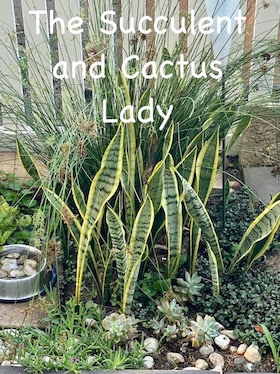
About me

About me
🌿 I've been gardening ever since a child, when I spent time with my father in his vegetable garden. But my fascination with Echeverias started in the 1980's, when my father gave me a pot with five Echeverias, which turned out to be E. imbricata. At first I wasn't much interested in them and planted them in some obscure corner of the garden and completely forgot about them. How great was my surprise when, a couple of months later, I noticed that they had spread and made a beautiful display - I was hooked!

Sunday, 28 September 2014

The outside room

As I look out to my garden
I feel a sense of pride
It really is a lovely room
Except it is outside!
~ unknown

A collection of succulents and ferns in my private bathroom-garden with a Pachypodium lamerei taking centre stage. Lots of rain, some tender loving care and the plants will smile at you. This area is fairly well protected from the cold, surrounded by high walls, but the frost does still get to the Sword Ferns. Luckily they spring back in all their glory again in spring. I've brought the Pachy and the Echeverias in the pots inside for the winter, but the basket is much too heavy to try and move. Besides which I don't have the space for it, unless I put it in the bath!

Looking from the garden into the bathroom
Looking from the bathroom into the garden
::
.

Wednesday, 24 September 2014

Succulent dish-garden


Succulents and cacti planted in a vintage enamelware bowl – Haworthia flanked by a Rattail Cactus and possibly a Haworthia lassytha to the right.

I find decorating with succulents and cacti lends a special air to any dinner setting when you have friends over. They look wonderful as a centre piece and never fail to get the conversation flowing!

 
 Add a few earthy elements like river pebbles and driftwood

::

Wednesday, 13 August 2014

Flowers of the Echeveria imbricata

Camera : Canon EOS 550D 
Taken in my garden (Tarlton, Gauteng, South Africa)

Echeveria imbricata is one of the most popular and beautiful succulents in the Crassulaceae family, native to semi-desert habitats in Mexico. They are not as frost-hardy as some other succulents and I bring mine in every winter. They used to be spread all over my garden, but after almost losing most of them, I transplanted them into various containers and now they are thriving like never before.


::

Saturday, 2 August 2014

Monster Echeverias


My Echeverias (E. glauca) responded in the most amazing way to all the rain we’ve had last summer, many days as much as 100mm – some are as big as saucers and, this one in particular, as big as a dinner plate.

These beautiful and varied tender succulents are not frost hardy. However, their ability to withstand drought is unsurpassed. Yet they thrive when given a lot of water. Originating in hot desert conditions in Mexico and South America, there are still new species being discovered today. The hybrids that we know and love are easy to grow and propagate, which only encourages that urge to acquire more.

Watch out, these plants are very addictive!

 In winter they have now taken on a more blueish hue...


::

Saturday, 26 July 2014

Echinopsis - 6am in Winter


6am in my garden one Winter's morning (Tarlton, Gauteng, South Africa) and still dark outside. My small Cacti (Echinopsis oxygona) were in full flower and they had appeared over-night, seeming to lighten this area with their beautiful lilac/pink flowers, which have a sweet smell. My Barrel cactus in the background, native to the Southwest Desert of North America, is approximately 15 years old.

Echinopsis oxygona is native to South Brazil, Uruguay and northern Argentina. Its features include many robust spines, spherical shape, and a large flower, with sharply pointed lavender petals, and a fine faint scent.


Echinopsis Oxygona grow prosperousely in full sun, or light shade. These cacti can stand through strong heat, and even through temperatures as low as -10°C (14°F). Usually these are outdoor plants. These plants are used to the dry, desert climate, so they do not need to be watered every day.

Camera : FujiFinepix 2800Zoom Digital - flash enabled

.

Sunday, 20 July 2014

Aloe ellenbeckii


Family: Aloaceae
Genus: Aloe (AL-oh)
Species: ellenbeckii (el-len-BEK-ee-eye)

These low-growing, drought-tolerant aloes grow in sun to partial shade and start flowering mid-Autumn to early-Winter. Aloe ellenbeckii is a widespread species in East Africa, but he population may be in slow gradual decline due to loss and degradation of it's habitat - natural areas in the region where Aloe ellenbeckii occurs are increasingly under pressure from agricultural expansion.

Aloe ellenbeckii grows in partial shelter of bushes in deciduous bushland on limestone. Small plants are clumped together, and clumps are scattered. The plants have fleshy thick leaves of beige and light-green with rows of lighter toned dots that are placed up and down each leaf. The Aloe ellenbeckii produces beautiful white teeth on its leaves, with a variegated spot look. The new plants produced by the Aloe ellenbeckii spread loosely across the landscape into large colonies. 


.

Thursday, 17 July 2014

Peanut cactus (E. chamaecereus)


The common name of 'Peanut cactus' comes from the peanut-like offsets that this cactus provides generously along the stems. These offsets can be detached and planted immediately.

Echinopsis chamaecereus is a small clumping cactus, about 4 inches (10 cm) high. If the stems become longer than this, they tend to lay down on the ground or hang from the pot – grown in more shade than it prefers Peanut Cactus will sprawl and hang quite nicely over the edges of a pot. They therefore look great in hanging baskets. But don't water this cactus too much - it causes the mother plant to rot away, leaving the offsets stranded or falling off if they're hanging over the edge - rather err on the side of giving too little water.


The Peanut cactus grows well in the shade, but tends to form long, hanging ropes, which are easily controlled by just cutting them off and planting them again.


The beautiful flower of the Peanut cactus.


In full sun, the Peanut cactus tends to be more clumpy, but I have two that are in full sun that have still sent out long, hanging ropes. If your cactus is used to shade, introduce it to sunlight gradually as they easily get burnt.

.

Sunday, 13 July 2014

Aeonium


Aeonium are without a doubt, some of the most beautiful and sought after additions to succulent collections. They reward our efforts with gorgeous spoon shaped foliage in shades of burgundy and green, sometimes variegated with splashes of palest gold.

In winter I do not remove the dead bottom leaves as they provide protection against the cold
.
Aeonium are native to the Canary Islands and North Africa, so you may be able to guess their preferred conditions - warm, or even hot would be the key word.
.
The name means 'evergreen' so this is a plant that never loses its leaves – until after it blooms that is, when the flowering rosette dies. But by then you should have lots of pups to keep this plant going.


Aeonium grow best where minimum temperatures are about 4 degrees Celsius; they can’t take any frost, so a sheltered or indoors environment only for this plant. It requires good ventilation, and bright light – full sun is fine, or partial shade. They prefer a little more moisture in the soil than many other succulent plants. Water as soon as the soil is dry, but don’t allow it to dry too much.

Aeonium in the pot at the back and to the right, in front is Echeveria glauca, which shows the difference between these two species
.
Some Aeonium will form a fairly tall stand of rosettes of green, dark burgundy or variegated foliage each on the top of a slender stalk. The leaves are spoon-shaped, sometimes glossy, and occasionally matte.
They can reach a height of a meter (3'), or less than 15cm (5"), depending on the variety. Other species and varieties are suitable for mixed planters and succulent crafts as they tend to be more compact.
Easy to propagate, just remove a rosette with a piece of stem and allow to callous overnight and the stem end can be planted into a pot.

Aeonium - the lovely pink tinges that emerge in winter

Burgundy-tipped Aeonium sharing a pot with an Aloe, some Crassula and a cactus


Aeoniums are members of the Crassulaceae, a huge family of succulents that include many other popular and commonly grown succulents, including some that look a lot like Aeoniums.  Echeverias in particular are often confused with Aeoniums and there are several other rosette-like succulents (eg. Dudleyas, Graptopetalums, Pachyverias and Graptoverias).  One thing that sets t these plants apart is the way their leaves attach to the stem - they are wrapped around the stem with a fibrous attachment so that when a leaf is pulled away, the stem is intact with only a transverse line showing where the leaf was attached.  The other rosette Crassulaceas have succulent attachments and their being pulled off the stem leaves a divot in the stem.

.

Wednesday, 9 July 2014

Winterizing succulents


Every Autumn I get most of my succulents ready to come indoors by gradually decreasing the amount of water they receive and as it gets colder, when temperatures reach about 5℃, I bring them inside. Even though both the Crassula and Aeoniums in this pot can withstand a fair amount of cold, I’d hate to lose them, so rather safe than sorry!

Crassula imperialis (the spidery one on the left) prefer very porous soil, and it is preferable to drench them well and allow the soil to dry somewhat between waterings. They enjoy cool summer conditions, good light, and good air circulation. High heat in the summer, when they are dormant, will often cause lower leaves (those tiny little dots are leaves!) to drop. Crassula need winter warmth and will sit and sulk if kept damp and cold. Crassula is easily propagated by just breaking off a piece and sticking it into the soil and before long you will be rewarded by a lovely, spreading little plant.

Aeonium (tree houseleek – (on the right) is a genus of about 35 species of succulent, subtropical plants of the family Crassulaceae. The name comes from the ancient Greek “aionos” (ageless). While most of them are native to the Canary Islands, some are found in Madeira, Morocco, and in East Africa (for example in the Semien Mountains of Ethiopia).

The rosette leaves are on a basal stem. Low-growing Aeonium species are A. tabuliforme and A. smithii; large species include A. arboreum, A. valverdense and A. holochrysum.
Aeonium are not frost-resistant. They are related to the genera Sempervivum, Aichryson and Monanthes, which is easy to see from their similar flower and inflorescences. Recently, the genus Greenovia has been placed within Aeonium.

 These Aeoniums in a pot spend the summer outside and then also come inside for the winter

::


.

Tuesday, 17 June 2014

Aloe ferox splendour


My aloes (this is Aloe ferox, also known as Bitter aloe) have started flowering and I'm beside myself with joy! Two seasons ago I had no flowers, an early frost annihilated the lot just as the buds started. I actually know what the problem is - since I planted them 7 years ago, the trees surrounding them have grown huge, resulting in a lot of shade. So I have two options - cut down the trees (no ways!) or move the aloes to full sun, which is going to be a huge task. As you can see from the photo below, taken this past summer, they are very big and I'm not looking forward to this mammoth task. Wouldn't it be easier to lose them (sob, sob!) and just plant new ones in a sunny spot...?


This hardy plant is indigenous to South Africa, and with its succulent leaves can survive the harshest conditions. When damaged by man or animal, the plant seals off any wound with a sticky, dark liquid that prevents infestation by virus, fungus or insect. This dark liquid has been successfully used by ancient inhabitants as a traditional remedy for many ailments.

.

Sunday, 18 May 2014

Echinopsis cactus


Family: Cactaceae
Subfamily: Cactoideae
Tribe: Trichocereeae
Genus: Echinopsis

Echinopsis grows pretty much anywhere. Here in South Africa they can tolerate summer temperatures of 30°C or greater, which is hot enough to spur growth of both Echinopsis pups and their amazing flowers. They also tolerate cold temperatures well during winter months. However, I bring my potted ones inside during hard freezes or their water-filled bodies will freeze as well.

Compared to most cacti, Echinopsis bloom fast and furious. They typically begin blooming in spring. Most blooms only last one or two days and they frequently open at night. But it’s common to have several buds on one plant developing at different rates; so a single plant can be in bloom for several weeks.


As a general rule, the smaller the diameter of the blooms a Echinopsis species produces, the more blooms the plant produces. Species that produce monster blooms (some over 6” in diameter) tend to have fewer blooms as so much plant energy goes into producing each one.

Echinopsis generally begin to produce flowers when they are two or three years old.

Echinopsis is a large genus of cacti native to South America, sometimes known as hedgehog cactus, sea-urchin cactus or Easter lily cactus. One small species, E. chamaecereus, is known as the peanut cactus. The 128 species range from large and treelike types to small globose cacti.


Echinopsis are greatly hybridised, but the species I have in my garden do well throughout summer and winter, always bearing huge, beautiful pink blooms in spring.

 Echinopsis flowering next to my Golden Barrel cactus

::

Saturday, 10 May 2014

Pachypodium lamerei


Camera : Fuji FinePix 2800Zoom
Taken in my garden (Tarlton,Gauteng, South Africa)

Pachypodium lamerei has a tall, silvery-gray trunk covered with sharp 6.25 cm spines. Long, narrow leaves grow only at the top of the trunk, like a palm tree and is often marketed as the “Madagascar Palm”, despite it not being a palm at all. It is a stem succulent and comes from the island Madagascar.


It rarely branches, except here in Tarlton! With every consecutive frost it got a new branch in Spring. Sadly to say, after being in my garden for several years at a height of 3 meters, a particularly severe frost killed it a couple of winters ago. Plants grown outdoors will reach up to 6 metres. When grown indoors it will slowly reach 1.2-1.8 m tall.


Plants grown outdoors will develop large, white, fragrant flowers at the top of the plant. It rarely flowers indoors.


I don't usually replace plants that die or are not suitable for our area, but shortly after my Pachy died, I came upon one at a succulent show in 2008 and guess what? I couldn't resist buying it!

New Pachypodium in 2009 

It has now grown from a 6" baby into almost a meter tall. I've been bringing it into the house every winter, but after it's first transplant into a bigger pot, it has grown so big that it is a problem carrying it in. Will have to drag the old garden trolley out of the store room...

Pachypodium lamerei in 2010 

Pachypodium lamerei, having out-grown his pot and just before being transplanted late 2012

My Pachy after being transplanted in Oct 2013 

Pachypodium lamerei in March 2014 (see how the Echeverias have grown also!)

If you have a frost-free climate, these are one of the most stunning succulents to have in your garden and makes a beautiful feature plant.

.
Related Posts Plugin for WordPress, Blogger...